

For many, motorcycles are all about the emotional connection between rider and machine. This includes the feel of controls, especially the clutch.
Electric motorcycles have removed the clutch, although they bring other emotional connections to the machine, including instantaneous torque and the surreal feel of riding without sound.
Honda is making a game-changing connection change to fuel-powered engines and their clutches with its new “e-clutch” system. The system is not fully automatic like Honda's Dual-Clutch Transmission (DTC) but is way more technically advanced than a slipper clutch.
It begs the question: Is this technology about to change the way we experience riding, or will it end up as another forgotten footnote, like some of Honda's past innovations (airbag on a Goldwing, anyone?).
We're waiting for a few of these Hondas to hit the Twisted Road platform so we can rent one and discover for ourselves.
But for now, let’s explore the Hondea e-clutch and how it compares to/differs from the Honda DTC and slipper clutches.

What is a Honda e-Clutch and How Does it Work?
In simple terms, a Honda e-clutch bridges a traditional manual transmission and an automatic.
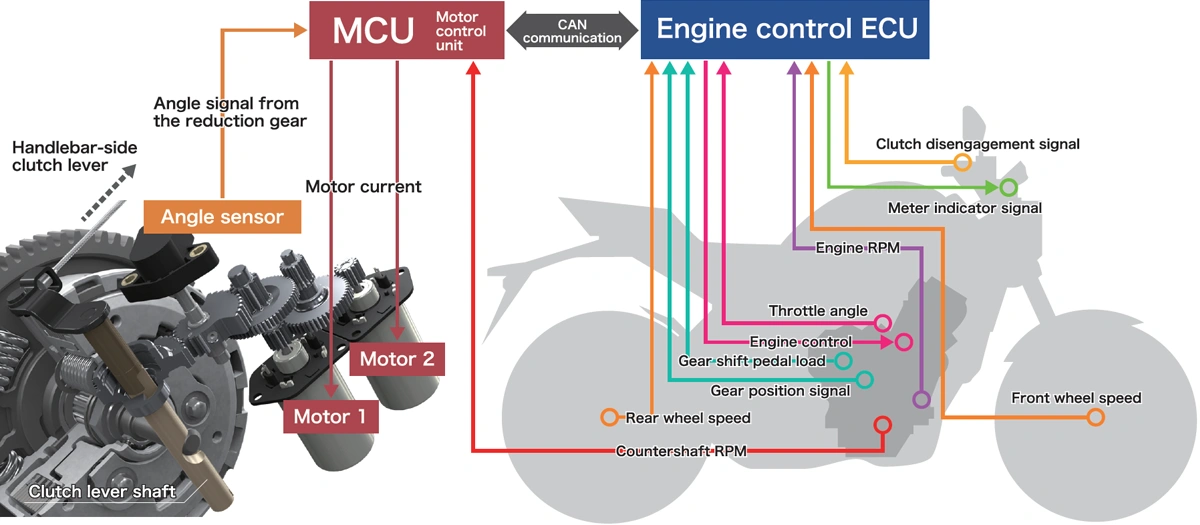
The e-clutch system relies on a pair of electric motors to manage the clutch work. This lets the rider shift up or down without touching the clutch lever—essentially a more advanced quickshifter.
But when you come to a complete stop, even in gear, the bike will not stall. When you're ready to take off, just engage the throttle; no clutch work is needed. Check out the image below for a visual look.
Honda’s e-clutch debuted on its 2024 European CBR650R and CB650R models earlier this year and finally made its way to America on the same models for September.
While many riders are skeptical about new technology, initial reviews on Honda’s e-clutch have been overwhelmingly positive. For a great overview, check out Adam Waheed’s Motorcyclist review of the e-clutch on the CB650R.
How Does a Honda E-Clutch Compare to Other Systems?
Many motorcycle brands have adopted similar technology but with different approaches. Most manufacturers use a slipper clutch in their transmissions.
Honda has combined its version of the e-clutch with its existing slipper clutch technology to add another dimension to how seamlessly a downshift feels.
Then there's the option of going fully automatic, with systems like Honda’s own DCT (Dual Clutch Transmission), commonly found on the Africa Twin adventure bike and several other models.
Here’s a quick breakdown of each:
Slipper Clutch
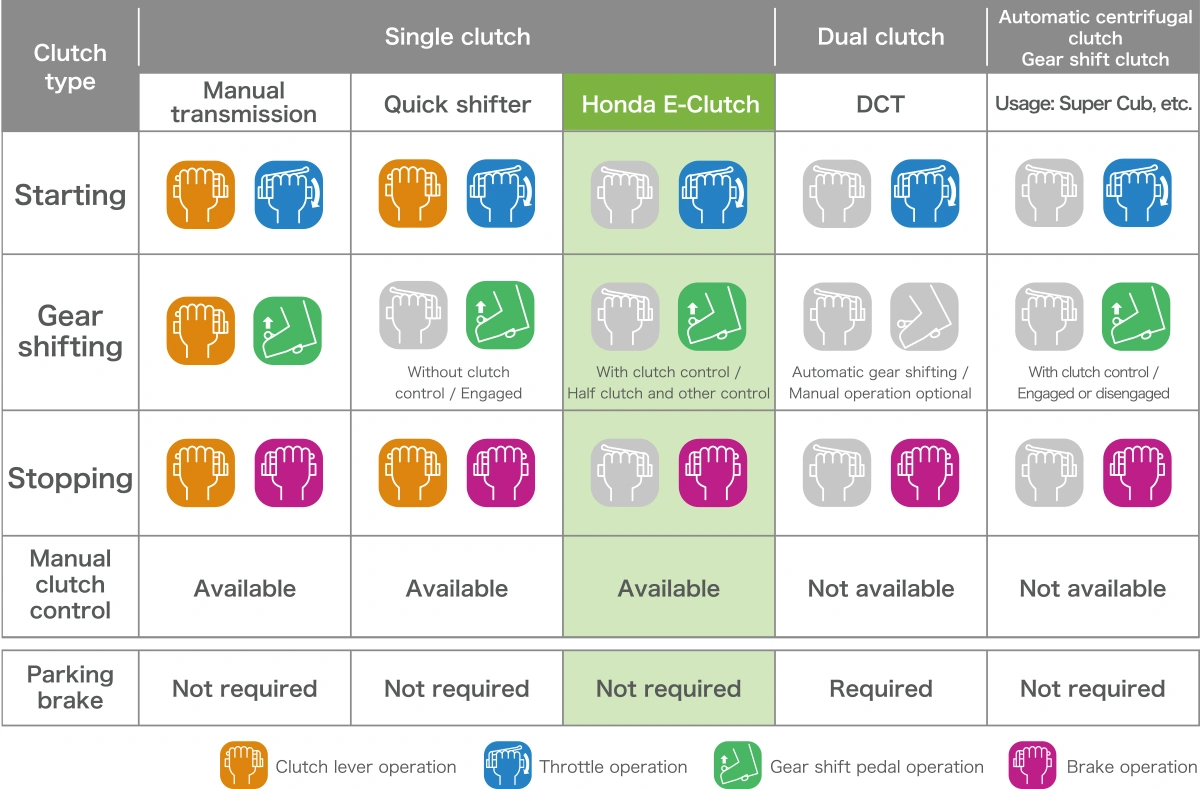
A slipper clutch helps prevent rear-wheel lockup during aggressive downshifts. While it’s a valuable addition, it still requires manual clutch operation.
A slipper clutch, or back-torque limiter, is designed to minimize the impact of engine braking during aggressive downshifts. It works by allowing the clutch plates to slip slightly, reducing the force transferred to the rear wheel.
This controlled slip helps prevent the rear wheel from locking up, ensuring smoother downshifts and better stability, especially in high-performance riding scenarios.
Honda e-clutch takes things a step further by automating the entire process.
Dual Clutch Transmission (DCT)
In 2010, Honda revolutionized motorcycling with the introduction of the first-ever dual-clutch transmission (DCT).
The Dual Clutch Transmission automates clutch and shift operations while maintaining the direct feel of a manual transmission. This eliminates the need for manual clutch operation, allowing the rider to focus on throttle and braking, with smoother power delivery and fewer interruptions during gear changes.
DCT uses two clutches: one for 1st, 3rd, and 5th gears, and the other for 2nd, 4th, and 6th. It offers two modes: AT mode for automatic shifts and MT mode for manual gear selection. Riders can choose between D mode for normal riding and S mode for sportier performance, with the system seamlessly returning to automatic after shifts.
Over time, the technology has been refined and expanded, debuting in the NC700 and CTX700 series in 2012. By 2016, the DCT was introduced to the CRF1000L Africa Twin, adding more versatility for off-road use. Further improvements in 2020 made the system smoother and quieter, enhancing rider control.
The Honda e-clutch provides a middle ground: It keeps the feel of a traditional manual transmission but offers the convenience of clutchless shifts.
Think of it as having your cake and eating it too. You maintain control, yet you get that added layer of smoothness. It might seem odd at first, not reaching for that clutch lever, but experienced riders who have spent time with an e-clutch say it becomes second nature very quickly.
The Benefits of a Honda e-Clutch: Smooth Operator
For new riders, learning to manage clutch control is often a major hurdle. The e-clutch eliminates that learning curve, making motorcycling more approachable for beginners. Imagine starting on a hill—no more worries about rolling back or stalling out.
Even for experienced riders, e-clutch offers advantages. Imagine you're navigating rush hour traffic on your CB650R, constantly using the clutch can get tiring for your hand and forearm. E-clutch allows you to effortlessly glide through those start-stop situations.
However, what makes the Honda e-clutch especially clever is its adaptability. Although the system can handle the clutch work for you, it doesn't lock you out entirely. You can choose to use the clutch lever whenever you prefer, and the system will seamlessly revert back to full manual mode.
This will make it ideal for adventure and dual-sport bikes, which rely on clutch slipping for various riding techniques, such as allowing the engine to rev slightly higher when reestablishing traction.
You have full control. Plus, you can even adjust the system sensitivity, fine-tuning it to your liking.
Honda e-Clutch: Here to Stay or Doomed to Fail?
Who remembers the airbag-equipped Gold Wing, or the oval-pistoned NR750? Both were technologies intended to make motorcycles safer or faster, but for one reason or another, neither really caught on (though all collectors want an NR750 in their collection!).
Will Honda's e-clutch system join Honda’s innovative but ultimately discarded technology graveyard, or will it change motorcycling as we know it?
Only time will tell. However, early indications point toward a much brighter future for this innovation. It addresses a genuine rider need. Plus, unlike those other innovations, this technology arrives with a strong value proposition: it simplifies riding without compromising engagement, making it appealing to a broader range of riders.
FAQs
What bikes have an e-clutch?
Currently, Honda only offers its e-clutch technology on the 2024 and newer CB650R and CBR650R models. Honda began offering these bikes with e-clutch in the US market beginning with the 2024 model year. It is unclear yet which models Honda plans to release the technology on in future model years.
What does Honda's E-clutch do?
The e-clutch is not an automatic transmission. Instead, the technology allows you to shift gears without operating the clutch lever, even when starting from a stop or coming to a stop.
Is the Honda E-clutch coming to the USA?
Yes, Honda started selling the CB650R and CBR650R, which are equipped with its e-clutch system, in the USA starting in September 2024 as part of its 2024 model year release.